
This Women’s History Month, I’d like to give a big shout out to Mary Jane herself. The buds that we smoke are all derived from female marijuana plants, giving us the most powerful effects, delectable flavors, and running an entire industry on their back. Luckily, the plant is supported by some pretty powerful women who cultivate and care for the many iterations of Jane. Particularly those whose being is inextricably linked with cannabis’s own story and place in the world. To tell the tale of how she and her feminist counterparts came to such proliferation in Central Massachusetts, I think it’s best to rewind our story to just under 150 years ago.
Between 1830 and 1850, industrialization hit Worcester with a boom. The population skyrocketed fourfold thanks to the newly implemented railroad system and the growth of various manufacturing opportunities. This opened social commentary to how this newfound industrialization would benefit city dwellers after the destruction that it brought upon similar paths of growth in England. Just up the road in Seneca Falls, New York, women banned together for their rights, the birthplace of the movement spreading like wildfire across the Northeast. As activism spread, plans were drawn for the First National Women’s Convention — right here in the heart of our city!
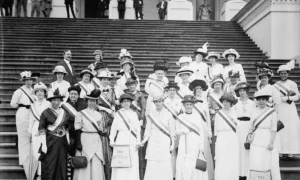
The First National Women’s Convention was held on October 23rd and 24th of 1850 and had a whopping 1000 individuals in attendance. An important note is that many of the women involved were also active in the abolitionist fight. This intersectionality enabled them to stand for both equality of sex and color; fundraising, speaking, and organizing while agitating for both the abolition of slavery and equality of women. The mutual struggle created a common ground where revolutionaries like Sojourner Truth and Harriet Tubman stood in solidarity alongside women of all backgrounds over their shared economic, social, and political struggle. Truth spoke at the convention on the need to fight for enslaved women which led to a resolution in which the attendees unanimously expressed support for “the trampled women of the plantation.” The inhumane conditions of black women rose in an insurgence that continues to be fought today.
The local organizer who called the convention to order, Sarah H. Earle, founded the Worcester Ladies Anti-Slavery Sewing Circle and was a key contributor to the Worcester City Anti-Slavery Society. Many organizations rose to fruition during this time period, allowing women to work together towards social reform outside of the convention space. Groups like the YMCA, NAACP, and Women’s Progressive Club were kept alive and sustained by fundraising committees of black church ladies, organizing, running, and benefiting social causes. Continuing intersectionality rose to the front lines with black women more overtly involved in education and the arts. This included inspiring individuals like Jennie Cora Clough Busby who was the first certified black teacher in the Worcester public school system and Inez Clough who was a Worcesterite at the forefront of the return of all-black musical shows to Broadway after nearly a decade-long silence.

Flash forward to today and we see many women rising to the top of their trade across Central Massachusetts. As a black-owned business fighting for social equity, we think it’s of utmost importance to continue highlighting powerhouses of intersectionalism. Take Payton Shubrick of 6 Bricks, a dispensary in Springfield. Shubrick spoke at our Community in Bloom: Social Equity and Expungement Forum that was held this past May 2025 about her experience as a black woman in the cannabis space and how the idea of “social equity” has not benefitted the individuals it so valiantly preaches to aid. Browse through the genius of Major Bloom’s very own Bria Graham with her clothing brand Driptique, at the forefront of what a black-owned vision can bring to fashion space. Our very own Nana Amaning of Luxe Nails By Nana, the most thoughtful and detail-oriented technician who never fails to have our team’s nails on point. We house artwork by Ice the Style Specialist on our dispensary retail floor, a leading artist in the Worcester community focused on storytelling through a lens that puts black bodies and their legacies in focus. Everywhere you turn in Central Massachusetts there is a business or person celebrating what it means to live life through the multidimensionality of womanhood.
While so many women are working their way up as individuals within cannabis, there are also cohorts dedicated to bringing them together. Conferences still exist, whether in-person or digitally, and continue to push for the empowerment and success of these women. The Women in Cannabis Association (WICA) offers educational resources, networking opportunities, advocacy support, mentorship, and business development support to women across the nation working within this burgeoning and ever-changing market space. There’s also a Women in Cannabis Expo that has taken place every March since 2021 in Reno, Nevada. At the convention there are speakers, panel discussions, and booths filled with women from all corners of the cannabis biz. There is also Women Employed in Cannabis, an international association for women working in cannabis, psychedelics, hemp and CBD. They pioneer advocacy, sisterhood, and a fighting spirit that works to ensure the industries are equitable, diverse, and inclusive.
I had the absolute pleasure of hopping on a call with Caron Cooper of Women Employed in Cannabis (WEIC) to chat about the organization and her vision as she stands at the head of the helm. Cooper’s energy was infectious as she described

her “labor of love” in bridging gaps between women in the industry and offering a network and resources to empower them. She is a self-taught web designer who moved across the country in 2017 to Seattle, WA, in order to kickstart her own business called CannaSite. Two years ago she took over WEIC after being a member of the group through her work on CannaSite. Now, she guides the organization with insatiable listening and a deep understanding of how to uplift, support, and guide fellow cannabis entrepreneurs and advocates. WEIC hosts at least two monthly online seminars where women from all corners of cannabis bounce ideas off of one another and shout their individual messages out into a world and industry that is constantly evolving. Excitingly, the organization is expanding off of social media and onto a new app platform, as well as building out their directory for ease of access and connection amongst members. As a new member of WEIC, I highly encourage women in the industry to sign up (for free!) to connect with their community and find support in this impactful organization.
It is inspiring to see so many others attuned to the “canna boss babe” lifestyle and making it as fruitful as possible. Despite living in the 21st Century, barriers to growth and opportunity continue to bog down our social climate. We need to continue learning from women who understand what it’s like to be battered and bruised by a world that scrutinizes their growth based on nothing but pre-conceived notions of otherness. Mary Jane herself has been criminalized for such reasons. This makes it all the more important to support the women of this world as their care-taking, compassionate, and grounded perspectives water the garden of our collective joy. Let the most under-mined and under-recognized be successful storytellers and leaders in the world of Mary Jane’s wonders so that she might carry, in soil and purpose, the stamina and heart-opening effects that she and her fellow women so generously provide.
By Rachel Smith
Resources:
https://womenincannabisassociation.com/programs
https://www.wwhp.org/historical-library
https://worcesterhistorical.com/remarkable-women-of-color-in-worcester/
https://crossworks.holycross.edu/cgi/viewcontent.cgi?article=1008&context=oflifeandhistory
https://womenemployedincannabis.com/about/
https://womenincannabisexpo.com/
https://march.international/black-ecologies-an-opening-an-offering/